In-situ Soft X-ray Absorption Spectroscopy Testing of All-Solid-State Battery during Charge-Discharge Process
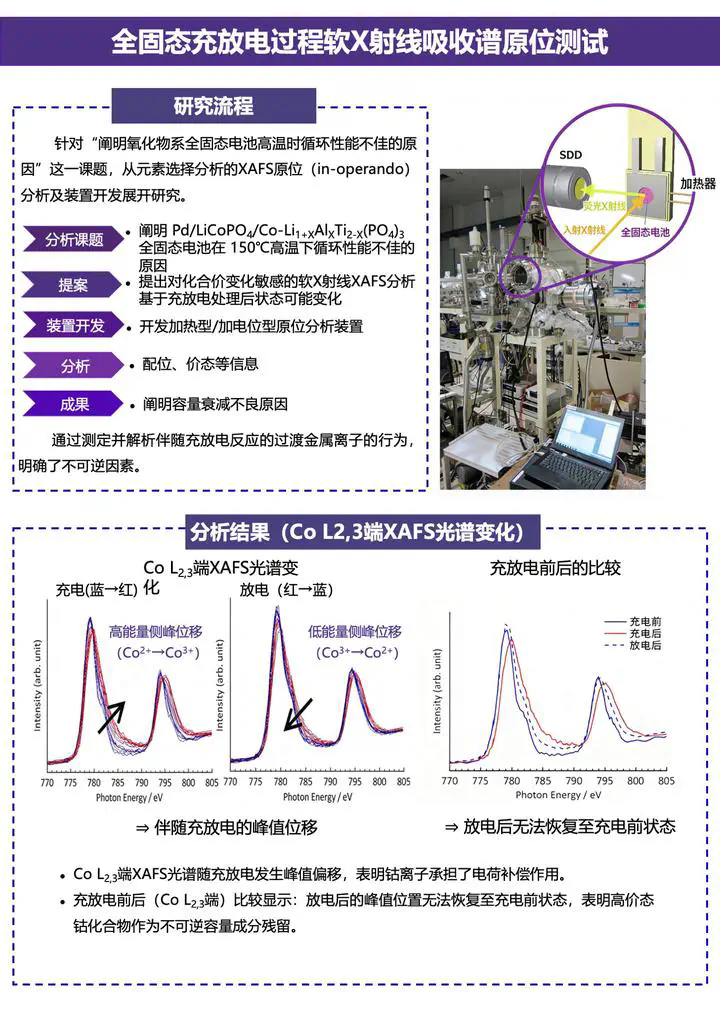 Image credit: Unsplash
Abstract
This figure presents the in-situ characterization results of the cobalt (Co) L₂,₃ edge in the cathode material of an all-solid-state battery using soft X-ray absorption spectroscopy (XAFS). By comparing the spectral changes before charging, after charging, and after discharging, a reversible shift in the valence state of cobalt ions during charge-discharge cycles was observed: the spectral peak shifted to higher energy during charging (oxidation of Co²⁺ to Co³⁺) and to lower energy during discharging (reduction of Co³⁺ to Co²⁺), demonstrating that cobalt ions play a charge compensation role in the electrochemical reaction. However, the spectrum after discharging did not fully return to its pre-charge state, indicating that some cobalt remained irreversibly in a high-valence state, contributing to capacity fade.
The technical sophistication of this test lies in the realization of in-operando soft X-ray analysis under high-temperature (150°C) and electric field conditions, enabling real-time capture of changes in the valence state and coordination environment of transition metals under realistic operating conditions. Soft X-rays are highly sensitive to the electronic structure of light elements and 3d transition metals, making them a critical tool for investigating redox mechanisms in battery materials.
In all-solid-state battery research, interfacial stability and elemental valence evolution are core scientific issues affecting cycle life. This in-situ XAFS method provides direct evidence for unraveling the atomic-scale mechanisms of capacity fade at elevated temperatures, facilitating the design of cathode materials and interface optimization, and advancing the practical application of all-solid-state batteries with high safety and high energy density.

Prof. Xiao Gao
Associated Researcher
My research interests include distributed robotics, mobile computing and programmable matter.