World's First Real-Time Observation of Potential-Dependent Microstructural Changes in Ionomer Films Under Liquid Total Reflection Conditions (2026.01.31)
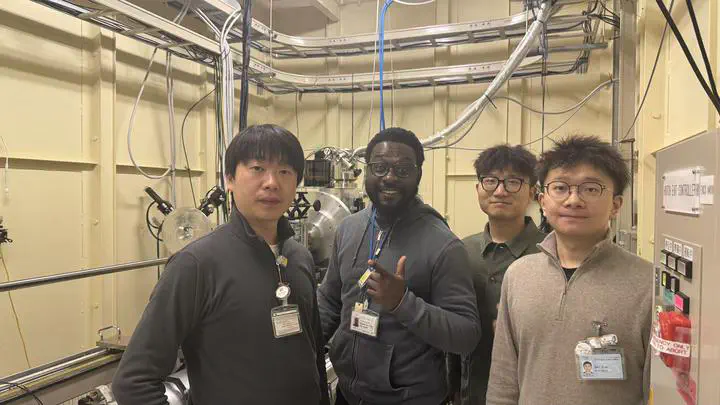
Wolrd first Voltage applied operando GIWAXS chracterization
This research team has successfully conducted in situ Operando GI-WAXS (Grazing-Incidence Wide-Angle X‑ray Scattering) experiments at the BL40B2 beamline of the SPring-8 synchrotron radiation facility in Japan, achieving the world’s first real-time observation of potential-dependent microstructural changes in ionomer films under liquid total reflection conditions. The experiments were performed using a self-designed and developed in situ electrochemical GI‑WAXS device, which enabled high-sensitivity surface and interfacial structure analysis of ionomer films in a liquid environment under applied potentials. This breakthrough overcomes the technical limitations of traditional solid‑state or non‑total‑reflection setups, which have been unable to capture the dynamic structural evolution of materials in liquid phases.
This study marks a new stage in the structural characterization of ionomers under electrochemical operating conditions, providing direct experimental evidence for understanding ion transport, phase‑separation behavior, and the coupling mechanisms between electrochemistry and structure at ionomer‑electrolyte interfaces in systems such as fuel cells and electrolyzers. It also establishes a methodological foundation for dynamic interface research in fields including flexible electronics and polymer electrolytes.
The researchers shown in the figure, from left to right, are:
Xiao Gao (Project lead, experimental design)
Albert Mufundirwa (Beamline testing assistance and optical alignment)
Yixing Chen (Synchrotron experiment operation and data acquisition, experimental design and coordination)
Buyi Bian (Synchrotron experiment operation and data acquisition)
Prof. Xiao Gao
Associated Researcher
My research interests include distributed robotics, mobile computing and programmable matter.