Comparative Analysis of Aromatic Sulfonated Polyamide and Perfluorinated Sulfonic Acid Ionomers: Implications for Polymer Electrolyte Fuel Cell Performance
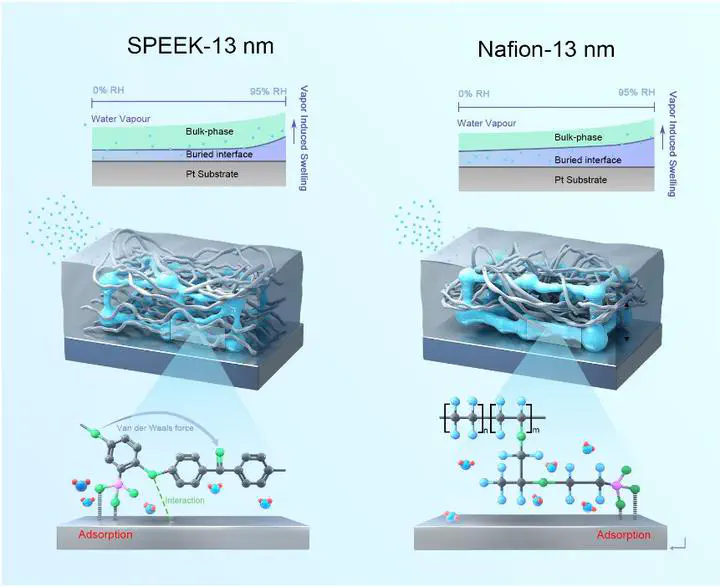 Image credit: Unsplash
摘要
The Ionomers critically impact catalysts layer performance in polymer electrolyte fuel cells (PEFCs). While sulfonated aromatic polyether-ketone (SPEEK) and Perfluorinated sulfonic acid-Nafion ionomers are widely used, their structure-property relationships under operating conditions remain insufficiently understood. In this study, we systematically analyzed Pt-supported SPEEK and Nafion films (13 nm) using in-situ ellipsometry, grazing incident wide-angle X-ray scattering investigate their morphology, water uptake, and proton transport properties. Compared to Nafion, the ultrathin SPEEK films exhibit dense, well-defined crystalline domains at the buried interface, attributed to a relatively stronger affinity for the Pt substrate. Analysis revealed that at 90%RH, the buried interface layer of SPEEK maintained a stable thickness of 13.8 angstrom, while Nafion exhibited a more pronounced swelling, increasing to 18.7 angstrom. Consequently, SPEEK thin films show reduced water uptake rates and conductivity, particularly under dry conditions. The proton conductivity measurements further highlighted a significant gap between in-plane and out-of-plane directions for SPEEK, with out-of-plane conductivity being 1-2 orders of magnitude lower, whereas Nafion displayed a smaller anisotropy. We propose that the intermolecular forces between ether groups, along with the interactions between Pt and oxygen atoms in the repeating units of SPEEK, contribute to the differences observed in the buried interface structure. This study enhances our understanding of ionomer-containing films in relation to molecular structures, confinement effects, and substrate interactions, thereby facilitating under fundamental investigations of catalysts-ionomer interface.